
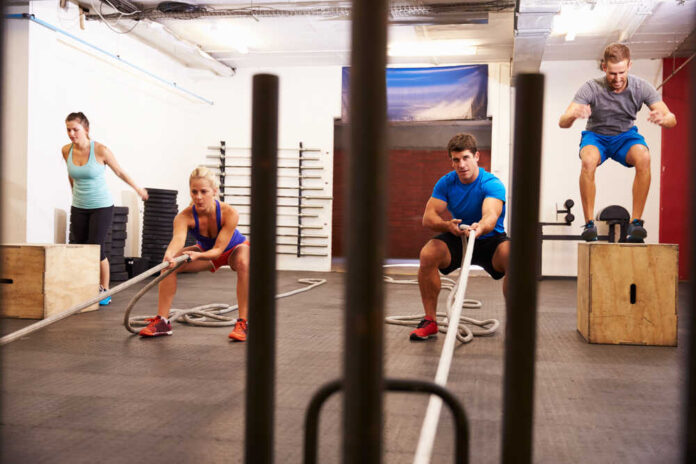
Some gym rats have a slightly masochistic side, and adore killer workouts; if you are one of them, then you might want to check out Peripheral Heart Action (PHA) training, also known as “Death Circuit” training. PHA is a style of circuit training that alternates exercises for the upper and lower body (and often push/pull) so blood shuttles between distant muscle groups. You keep the heart working hard while each local muscle gets brief breaks—allowing high training density without totally frying one area, and the results are a highly effective and efficient workout that could be defined as brutal, by some
Where PHA Came From
- Origin: Developed by physiologist Dr. Arthur Steinhaus and popularized in the 1960s by bodybuilder Bob Gajda (Mr. America).
- Why it stuck: It blends bodybuilding stimulus with endurance-like cardiovascular stress, letting you chase hypertrophy, fat loss, and work capacity in the same session.
Think of PHA as the “smart cousin” of standard circuits: it’s not just random stations; it’s strategic geography (upper ↔ lower, anterior ↔ posterior) to keep the heart busy and the local muscles rotating.
What PHA Actually Does
- Elevates heart rate steadily without long runs or bikes.
- Improves training density: more quality work per minute.
- Manages local fatigue: quads rest while you press; lats rest while you hinge.
- Delivers muscle stimulus: moderate loads near failure still count as hypertrophy work.
- Encourages peripheral blood flow: a practical way to pair strength-endurance and pump.
PHA vs. Other Popular Methods
| Method | Key Idea | When to Use |
|---|---|---|
| PHA | Alternate distant muscle groups (upper/lower) in circuits | Recomp, conditioning-with-muscle, time-limited sessions |
| Traditional Circuits | Any exercises back-to-back | General fitness, less targeted stimulus |
| Supersets | Two paired moves (often antagonists) | Hypertrophy density without full cardio focus |
| GBC (German Body Comp) | Big lifts + lactic emphasis, short rests | Aggressive fat loss with heavier barbell focus |
| EMOM/AMRAP | Work on the clock | Conditioning/skill density, typically less hypertrophy focus |
Programming Principles
- Exercise Order:
Alternate lower → upper → lower → upper. Within each, try anterior ↔ posterior (e.g., quads ↔ hamstrings/glutes; chest ↔ back). - Load & Reps:
- Hypertrophy-leaning PHA: 8–15 reps at 60–75% 1RM, RIR 1–2.
- Strength-leaning PHA: 4–8 reps at 75–85% 1RM on the first move, then 8–12s for the rest.
- Rests:
- Between exercises: 0–30 sec (enough to transition).
- Between circuits/rounds: 60–120 sec (just enough to keep output crisp).
- Density Targets:
- Aim for 15–25 hard sets per session across the whole body.
- Session time: 35–60 minutes.
- Heart rate: often 70–85% max across working sets.
- Movement Quality:
Big compound lifts first in the circuit, then medium compounds, then accessories/isolation. Technique trumps speed.
The PHA Templates
- A) Classic 6-Station PHA (45–55 min)
Circuit (3–4 rounds):
- Front Squat or Goblet Squat – 8–10
- Pull-up / Lat Pulldown – 8–12
- Romanian Deadlift – 8–10
- Incline Dumbbell Press – 8–12
- Walking Lunge (each leg) – 10–12
- Chest-Supported Row – 10–12
Rest 60–90 sec, then repeat round.
Why it works: Quads → lats → posterior chain → chest → quads/hips → upper back. Continuous central demand, local relief.
- B) Strength-First PHA (powerlifters & strong folks)
Circuit (4 rounds):
- Back Squat – 4–6 @ 75–85% (RIR 2)
- Weighted Pull-up – 5–6
- Bench Press – 4–6 @ 75–85% (RIR 2)
- Hip Hinge (Trap Bar DL or Heavy RDL) – 5–6
- Landmine Press or Dips – 6–8
- Row Variation – 6–8
Rest 90–120 sec between rounds.
Notes: Keep reps crisp; this is not HIIT. The cardio comes from alternation, not sloppy form.
- C) Hypertrophy-Pump PHA (bodybuilding leaning)
Circuit (3–5 rounds):
- Hack Squat or Leg Press – 10–12 (2–1–2 tempo)
- Machine Row – 10–12 + 5 partials
- Split Squat (front foot elevated) – 10–12/leg
- Cable Fly or Machine Press – 12–15 (pause stretch)
- Ham Curl – 12–15 (peak squeeze)
- Lateral Raise – 15–20 (constant tension)
60–90 sec between rounds.
Result: Big pump, sustained HR, excellent stimulus-to-fatigue in machines.
- D) Minimal-Equipment PHA (home/kettlebell)
Circuit (5 rounds):
- KB Front Squat – 8–12
- Push-up or DB Floor Press – AMRAP−1
- KB Swing – 15–20 (snap, not grind)
- 1-Arm DB Row – 10–12/side
- Reverse Lunge – 10–12/leg
- Pike Handstand Hold or DB Overhead Press – 8–12
45–75 sec between rounds.
- E) “Machine Mile” PHA (joint-friendly)
Circuit (3–4 rounds):
- Leg Press – 10–12
- Chest Press – 8–12
- Seated Ham Curl – 10–12
- Pulldown – 10–12
- Leg Extension – 12–15
- Cable Row – 10–12
Walk 2–3 min between rounds if HR is too high.
Warm-Up & Cooldown
- Warm-up (7–10 min):
2–3 min light cardio → dynamic mobility (hips T-spine shoulders) → 1–2 ramp sets for the first two lifts. - Cooldown (3–5 min):
Easy walk or bike + breathing (4–6 slow nasal breaths) to downshift. - Do not skip either one
Progression That Works
- Week 1: Pick conservative loads; learn flow.
- Weeks 2–4: Add load OR reps if you kept RIR targets.
- Week 5: Bump density—same total work in less time (tighten transitions).
- Week 6: Deload: cut sets by 30–40% and keep RIR 2–3.
- Next block: Swap one movement per pattern to refresh stimulus (e.g., back squat → front squat; row → chest-supported row).
Density Metric: Total hard reps × load ÷ session minutes. Try to nudge it up 2–5% most weeks.
Where to Place PHA in Your Training Week
Goal: Recomp / Conditioning with Muscle
- 3 days PHA (Mon/Wed/Fri)
- Optional: 1 short easy cardio (Zone 2) on weekend.
Goal: Strength Priority
- 2 days heavy strength (e.g., upper/lower) + 1 day PHA (Friday finisher).
- Keeps conditioning up without stealing recovery.
Goal: Fat Loss (with weights)
- 2–3 days PHA + 1–2 low-intensity cardio days.
- Keep protein high and sleep tight.
RPE/RIR & Heart Rate—How It Should Feel
- Sets land around RIR 1–2 (last reps challenging but clean).
- Heart rate elevated most of the session, but you can still cue technique between sets.
- If HR won’t settle and form slips, add 30–60 sec between stations or lighten the load.
Common Mistakes
- Turning PHA into chaos: Random stations add fatigue, not stimulus. Plan the alternation.
- Going too heavy on everything: Save near-max loads for the first big lift; keep the rest in the hypertrophy zone.
- No progression: Time your rounds, log reps/loads, and chase a small improvement weekly.
- Poor transitions: Set your stations before the clock starts.
- Skipping legs or back: The heart’s “peripheral” dance needs both big regions.
Safety & Who Should Be Cautious
- If you have cardiovascular disease, arrhythmias, uncontrolled hypertension, or you’re pregnant/postpartum, get medical guidance and start with longer rests and lower loads.
- If dizziness appears, stop, breathe, and extend rest intervals.
Sample 8-Week PHA Mesocycle (3 days/week)
Weeks 1–4 (Accumulation):
- 3 PHA sessions (Template A/C mix)
- RIR 1–2, 60–90 sec between rounds, 18–22 hard sets/session
Week 5 (Intensity emphasis):
- 1 strength-leaning PHA (Template B) + 2 normal PHA
- A bit heavier on stations 1–2
Week 6 (Density push):
- Same loads, aim to shave 2–3 minutes from total time
Week 7 (Overdistance):
- Add one isolation station per circuit (e.g., calf raise or face pull), keep RIR 2
Week 8 (Deload):
- Reduce sets by 40%, keep the flow, leave fresh
FAQ Lightning Round
Is PHA good for fat loss?
Yes, high density + weights = solid caloric burn and muscle retention, as long as nutrition is dialed.
Will I lose max strength?
Not if you keep at least one heavy slot per session or one separate heavy day weekly.
Can beginners do PHA?
Yes, with simpler exercises, longer rests, and a coach’s eye for technique.
How is this different from CrossFit metcons?
PHA emphasizes planned alternation and controlled hypertrophy zones, not all-out intensity or complex technical fatigue.
PHA is a high-skill way to stack muscle stimulus, conditioning, and time efficiency in one workout. Rotate distant muscle groups, keep loads appropriately challenging, control rest just enough to keep the heart honest, and log your density so progress is real and not just the profuse sweat.
Copyright 2025, GoHealthier.com